
Stamped Concrete vs. Natural Stone Patios: Which Is Better for Coastal NC?
By Bullet Concrete Construction | Wilmington, NC | March 2026
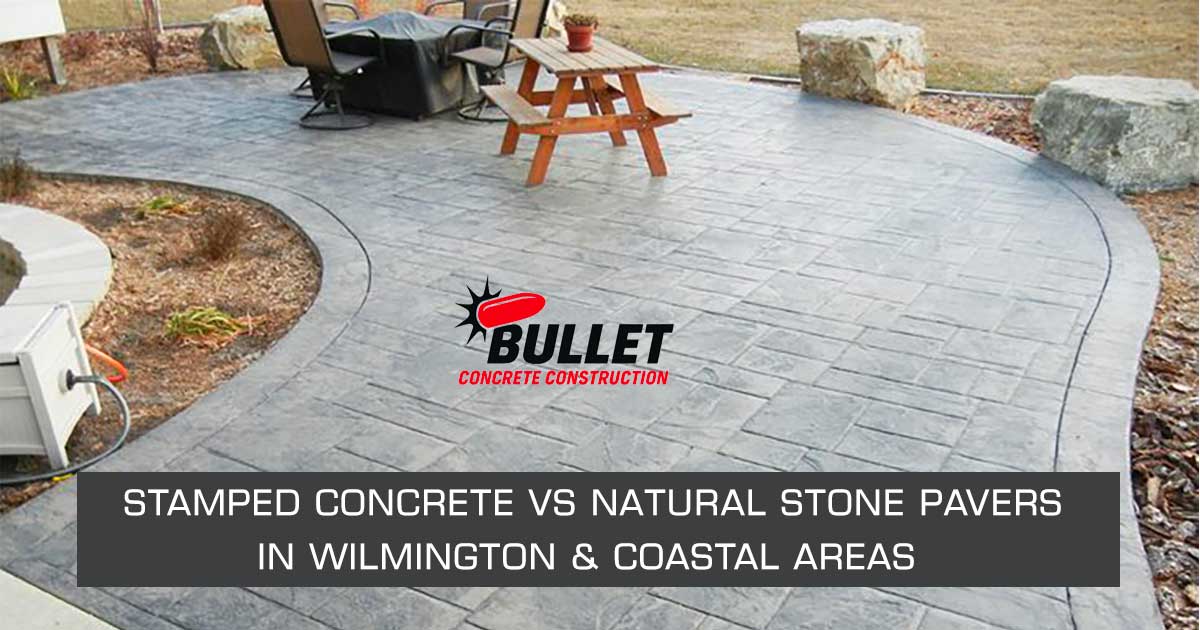
When homeowners in the Wilmington area start planning a new patio, two options come up more than any other: stamped concrete and natural stone. Both deliver the high-end outdoor living space that southeastern North Carolina's climate is built for — and both look impressive when installed well. But they're fundamentally different materials with different price points, different installation processes, different maintenance demands, and very different long-term performance in the conditions specific to our coast.
We just published a full comparison of concrete vs. pavers for driveways — this article applies the same honest evaluation to the patio decision. We'll cover cost, durability in coastal conditions, maintenance, design flexibility, and resale impact so you can make the choice that fits your property, your lifestyle, and your budget.
Cost: Stamped Concrete Delivers the Look at a Fraction of the Price
This is the most significant difference between the two options and the reason most homeowners choose stamped concrete over natural stone. A stamped concrete patio in the Wilmington area typically costs 40 to 60 percent less than a natural stone patio of the same size — and the gap can be even wider depending on the type of stone.
Natural stone — whether it's flagstone, bluestone, travertine, or limestone — is expensive to source, expensive to transport, and expensive to install. Each piece is a different shape, size, and thickness, which means the mason has to individually cut, fit, and level every stone by hand. The labor alone can exceed the material cost. On top of that, natural stone patios require a compacted gravel base, a mortar setting bed (or sand bed with grouted joints for a dry-laid installation), and significantly more installation time — a project that takes a concrete crew one to two days can take a stone crew a week or more.
Stamped concrete is poured as a single monolithic slab — the same process as a standard concrete patio — with the pattern and texture stamped into the surface before it sets. Color is applied through integral dyes mixed into the concrete and surface-applied hardeners and release agents that create depth and variation. The result is a surface that replicates the look of natural stone at a dramatically lower installed cost because the material is concrete, the installation is a standard pour, and the finishing work is done in hours rather than days.
Durability in Coastal NC: Same Climate, Very Different Performance
Southeastern North Carolina's combination of salt air, sandy soil, high water tables, heavy rainfall, and intense summer humidity creates an environment that tests both materials — but in different ways.
Settling and structural stability
A stamped concrete patio is a single continuous slab that distributes weight across its entire footprint. If a small area of the sub-base settles slightly — which is common on our sandy soil over time — the slab bridges the gap as a rigid unit. You won't see individual sections drop or shift because there are no individual sections. It's one piece of reinforced concrete.
A natural stone patio, whether mortar-set or dry-laid, is made up of dozens or hundreds of individual stones. Each stone is only as stable as the base directly beneath it. When sandy soil shifts — and it will — individual stones settle at different rates, creating an uneven surface with rocking stones, widening joints, and trip hazards. Mortar-set installations handle this better than dry-laid ones because the mortar locks the stones into a more rigid assembly, but even mortared joints crack and separate when the underlying base moves. On the barrier island properties in Wrightsville Beach and Carolina Beach where the soil is nearly pure sand, this settling is especially aggressive.
Moisture and algae growth
Natural stone is porous — significantly more porous than sealed concrete. In Wilmington's humid climate, that porosity becomes a maintenance issue. Moisture gets absorbed into the stone, creating a consistently damp surface that promotes algae, moss, and mildew growth — particularly on shaded patios or surfaces under tree cover. Flagstone and bluestone patios in southeastern NC frequently develop a green or black film within a year of installation that requires regular pressure washing or chemical treatment to manage. The textured, irregular surface of natural stone makes it harder to clean than smooth or stamped concrete because organic growth lodges in the stone's natural crevices and rough grain.
Stamped concrete is sealed after installation, which closes the surface pores and makes it significantly more resistant to moisture absorption. Algae and mildew can still grow on the surface in humid conditions — no outdoor material is immune to that in our climate — but it sits on top of the sealer rather than penetrating into the material, making it much easier to remove with a standard pressure wash. The smooth, sealed surface doesn't give organic growth anywhere to anchor the way natural stone's texture does.
Salt air and UV exposure
Salt air affects natural stone differently depending on the stone type. Limestone and travertine are particularly vulnerable — salt crystallization within the stone's pore structure causes surface flaking and spalling over time that's difficult and expensive to repair. Harder stones like bluestone and granite resist salt better but still absorb moisture that carries salt into the material. On waterfront properties in Southport and the barrier islands, this salt penetration is constant and cumulative.
Stamped concrete's sealer provides a protective barrier against salt intrusion — the same defense we use on every coastal concrete project. The sealer needs to be reapplied every two to three years to maintain protection, but while it's intact, salt can't reach the concrete's pore structure. UV exposure can fade the color of stamped concrete over time, but the sealer also includes UV-blocking properties that slow this process significantly. Resealing refreshes both the color vibrancy and the protective barrier in a single maintenance step.
Joint failure and weed invasion
Natural stone patios — especially dry-laid installations — have wide joints between stones that are filled with polymeric sand, mortar, or sometimes left with pea gravel. In Wilmington's climate, these joints are a constant maintenance battleground. Heavy rain washes out polymeric sand the same way it does on paver driveways. Mortar joints crack as the base shifts beneath individual stones. And every joint — regardless of fill material — becomes a channel for weed growth, grass runners, and ant colonization in our warm, humid growing season. Managing these joints is an ongoing task that most homeowners underestimate when they choose natural stone.
A stamped concrete patio has no real joints. The pattern lines stamped into the surface are purely cosmetic grooves in a continuous slab — they don't penetrate through the concrete and there's no fill material to wash out or degrade. Weeds, grass, and ants have no entry point. The only joints on a stamped concrete patio are the control joints engineered into the slab to manage shrinkage cracking, and those are sealed as part of the standard finishing process.
Maintenance: Stamped Concrete Is Dramatically Simpler
Stamped concrete patio maintenance
Reseal every two to three years. Pressure wash once or twice a year to remove dirt, mildew, and organic buildup. That's the full maintenance program. The resealing process takes a few hours, restores the color and sheen, and renews the protective barrier against moisture, salt, and UV — all in one step. Between sealings, the surface stays clean with a garden hose and occasional pressure washing. There are no joints to re-fill, no stones to relevel, no mortar to repoint, and no weeds to treat.
Natural stone patio maintenance
Natural stone maintenance in coastal NC is substantially more involved. Joints need to be re-sanded or repointed as they degrade — every one to three years depending on the fill material and how aggressively rain washes them out. Settled or rocking stones need to be lifted, the base re-leveled, and the stones reset. Algae and mildew growth needs to be treated regularly with appropriate cleaners — and you have to be careful with the cleaning agents because acid-based cleaners that work well on concrete can damage certain stone types like limestone and marble. Weed treatment in the joints is a recurring task throughout the growing season. Sealing natural stone is possible but more complex than sealing concrete because the stone's porosity varies by type and the sealer has to be compatible with the specific stone — an incompatible sealer can trap moisture inside the stone and cause it to flake.
Like pavers, the cumulative maintenance cost on a natural stone patio over 15 to 20 years can significantly narrow — or even close — the original price gap between stone and stamped concrete.
Design Flexibility: Natural Stone Has Authenticity, Stamped Concrete Has Versatility
Natural stone has one undeniable quality that stamped concrete can approximate but not fully replicate: it's real. Each piece of flagstone, bluestone, or travertine has unique color variation, natural veining, and an organic texture that comes from millions of years of geological formation. If absolute material authenticity is your top priority and budget isn't the primary constraint, natural stone delivers a patio surface that has a genuinely different feel underfoot and a character that only real stone provides.
That said, stamped concrete offers a wider range of design options than most homeowners realize. We can stamp patterns that replicate flagstone, ashlar slate, cobblestone, brick, wood plank, tile, and dozens of other textures — and combine them with integral color, accent colors, and border treatments to create custom designs that natural stone can't easily achieve. Want a flagstone-look patio with a brick border and a contrasting color band around the fire pit area? That's a single pour with multiple stamp patterns and colors — something that would require sourcing and installing multiple types of natural stone at significantly higher cost.
For homeowners across Wilmington, Leland, and Hampstead who want a patio that looks upscale, complements their home's architecture, and provides the outdoor living space southeastern NC weather is made for — stamped concrete gives you 90 percent of the visual impact at 40 to 60 percent of the cost, with a fraction of the long-term maintenance.
Repair: Different Materials, Different Challenges
Natural stone's repair advantage is that individual stones can be replaced without disturbing the rest of the patio — if you can find a matching stone. Natural stone varies by quarry lot, and finding a replacement piece that matches the color, thickness, and texture of the original can be difficult years after installation, especially if the stone type has been discontinued or the quarry has changed. Joint repair (repointing mortar or re-sanding) is straightforward but recurring.
Stamped concrete repair is different. If a section develops a structural crack from a sub-base issue, the damaged section can be cut out and replaced — but matching the exact color and pattern of the existing stamped surface requires skill and experience. The replacement section will be close but not identical to the weathered original, at least until the new section ages and the colors converge. Minor surface wear or fading is addressed through resealing, which refreshes the entire surface uniformly. For a deeper dive on when concrete repair makes sense versus full replacement, see our post on how to tell if your concrete needs replacement or just repair.
Resale Value: Condition Wins Over Material — Again
The same principle we covered in our concrete vs. pavers driveway comparison applies here: buyers and appraisers respond to the condition of the outdoor space more than the material it's made from. A well-maintained stamped concrete patio with vibrant color and a clean sealed surface adds more perceived value than a natural stone patio with algae growth, cracked mortar joints, settled stones, and weeds growing through the gaps. The material that looks better on listing day is the one that helps sell the house — and in practice, that's usually the one that required less maintenance to keep looking good.
In the higher-end communities of Wrightsville Beach and Southport, natural stone carries a luxury perception that can command a premium — but only when it's in pristine condition. In the majority of the Wilmington market, a stamped concrete patio is viewed as an upgrade over standard concrete and delivers strong resale impact at a price point that makes the investment easy to justify.
Side-by-Side Comparison
| Category | Stamped Concrete | Natural Stone |
|---|---|---|
| Installed cost | 40–60% less than stone | Premium pricing |
| Long-term maintenance | Reseal every 2–3 yrs, pressure wash | Repoint joints, relevel stones, treat algae, weed control |
| Settling on sandy soil | Monolithic slab bridges voids | Individual stones settle unevenly |
| Algae and mildew resistance | Sealed surface resists growth | Porous stone absorbs moisture, promotes growth |
| Salt air resistance | Sealer blocks salt intrusion | Varies by stone type; limestone vulnerable |
| Weed and ant resistance | No penetrating joints | Joints attract weeds and ants |
| Design options | Dozens of patterns, colors, borders | Authentic natural material, unique character |
| Installation time | 1–3 days | 5–10+ days |
| Typical lifespan (coastal NC) | 25–30+ years | 20–30 years (with heavy maintenance) |
| Repair | Section cut-and-replace; reseal refreshes surface | Replace individual stones (if matching available) |
The Bottom Line for Wilmington Patio Projects
Natural stone is a beautiful material. Nobody's arguing otherwise. But in a coastal environment with sandy soil, heavy rain, constant humidity, salt exposure, and aggressive biological growth, natural stone demands a level of ongoing maintenance that most homeowners aren't prepared for — and the cost of that maintenance over the life of the patio erodes the premium you paid for the material in the first place.
Stamped concrete gives you a high-end patio surface with the visual impact of natural stone, the structural integrity of a monolithic slab, and a maintenance program that consists of resealing and pressure washing. It costs significantly less to install, costs dramatically less to maintain, and performs better on sandy coastal soil where individual stones would settle and shift over time. For most homeowners in southeastern North Carolina, it's the smarter investment.
At Bullet Concrete Construction, we pour stamped concrete patios for homeowners across Wilmington, Leland, Wrightsville Beach, Southport, and the surrounding communities. We'll help you choose a pattern, color scheme, and layout that complements your home, then build it on a properly compacted sub-base with steel reinforcement, control joints, drainage pitch, and a professional seal coat — the full coastal installation that makes the difference between a patio that lasts decades and one that starts deteriorating in a few years.
If you're planning a new patio or upgrading an existing outdoor space, contact us for a free estimate. We'll visit your property, discuss your design ideas, show you pattern and color samples, and give you a detailed written quote with no obligation.
Related Articles
Concrete vs. Pavers for Your Wilmington Driveway: Cost, Durability, and Maintenance Compared
How Salt Air Affects Concrete in Wilmington, NC
Why Concrete Cracks in Coastal North Carolina (And How to Prevent It)
Concrete vs. Asphalt Driveways in North Carolina: The Full Breakdown
Poured Concrete Retaining Walls vs. Block vs. Timber: What Lasts in Wilmington's Climate
Explore Our Concrete Services
Concrete Driveways • Concrete Patios • Garage Slabs • Concrete Foundations • Retaining Walls • Stamped Concrete