
What Wilmington's Sandy Soil Means for Your Concrete Project
By Bullet Concrete Construction | Wilmington, NC | March 24, 2026
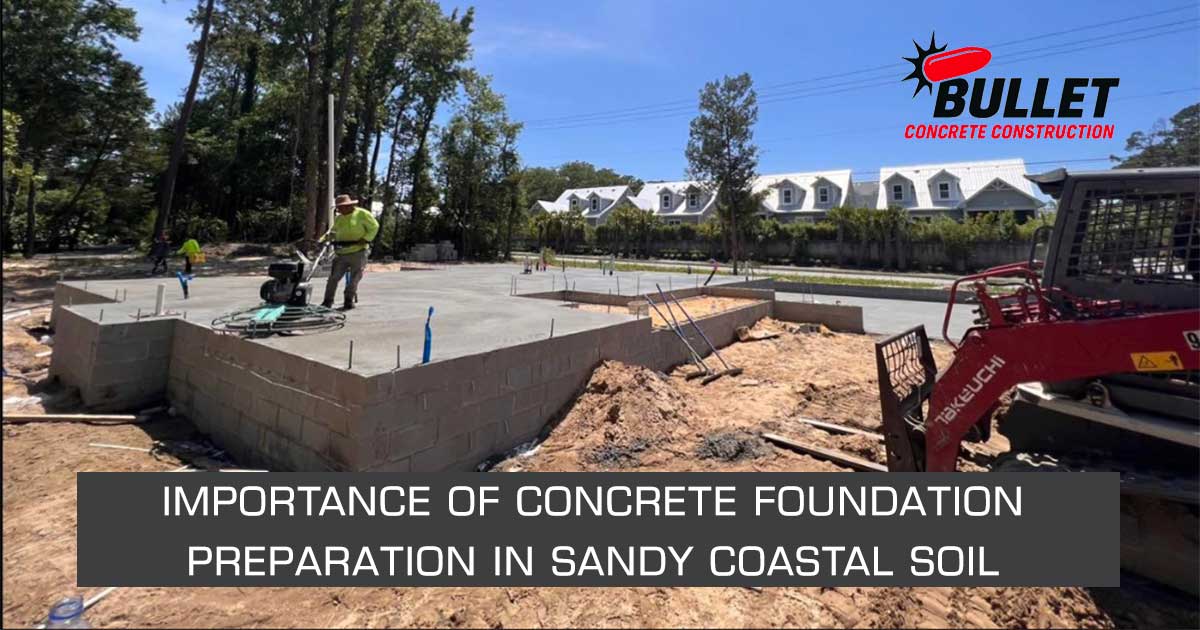
One of the first things any homeowner notices when they dig into their yard in Wilmington, Leland, or anywhere else in southeastern North Carolina is the soil — it's sandy. Sometimes it's light and loose, almost like beach sand. Other times it's mixed with clay or organic material depending on how close you are to the river or the coast. But the underlying reality across most of New Hanover, Brunswick, and Pender Counties is the same: the ground beneath your property behaves very differently from the clay-heavy soil found in the Piedmont or the rocky ground up in the mountains. And that difference has a direct impact on how long your concrete will last.
We covered the broader picture in our post on why concrete cracks in coastal North Carolina — sandy soil was one of the five causes we identified. This article goes deeper on that single topic: what's actually happening beneath the surface, how different parts of our service area present different soil challenges, and what proper sub-base preparation looks like when you're building on southeastern NC ground.
Why Sandy Soil Is a Problem for Concrete
Concrete is a rigid material. It doesn't flex, bend, or give. It sits on whatever is beneath it, and it relies entirely on that base to stay flat and evenly supported across its entire surface. When the base is stable, the slab performs exactly as designed — carrying vehicle weight on a driveway, supporting furniture and foot traffic on a patio, or holding the structural load of a foundation. When the base shifts, the slab has no ability to absorb the movement. It cracks.
Sandy soil creates this risk in two specific ways. First, sand particles don't lock together the way clay particles do. Clay has natural cohesion — it binds to itself and forms a dense mass that resists movement. Sand doesn't. Individual grains slide against each other under pressure, especially when they're loose or when water moves through them. Second, sandy soil is highly permeable. Water drains through it quickly, which sounds like a benefit until you realize what happens: the water carries fine particles with it as it moves, gradually washing material out from under the slab in a process called subsurface erosion. Over months and years, small voids develop beneath the concrete that weren't there when the slab was poured. When those voids get large enough that the slab is bridging empty space instead of resting on solid ground, the unsupported section fails.
How Soil Conditions Vary Across the Wilmington Area
One of the biggest mistakes homeowners and even some contractors make is treating all of southeastern North Carolina's soil as the same. It's not. The composition, moisture content, bearing capacity, and flood risk change significantly depending on where your property sits — and that variation directly affects how a concrete project should be prepared.
Barrier islands — Wrightsville Beach and Carolina Beach
Properties on Wrightsville Beach and Carolina Beach sit on almost pure sand with a water table that can be as shallow as two to three feet below grade. The soil has virtually no cohesion, and the combination of salt air and constant moisture exposure means any concrete poured here faces the most aggressive conditions in the region. We covered the full scope of these challenges in our post on how salt air affects concrete in Wilmington, but from a soil perspective alone, barrier island properties require the deepest sub-base preparation and the most aggressive compaction of any jobs we do.
New construction subdivisions — Leland, Hampstead, and Castle Hayne
The newer subdivisions in Leland, Hampstead, and Castle Hayne present a different challenge: fill dirt. When land is cleared and graded for a new development, the natural soil gets moved around, mixed, and often supplemented with fill material brought in from other sites. That fill may be sand, clay, a mix of both, or topsoil — and unless it was mechanically compacted in lifts during the grading process, it can settle unpredictably for years after the homes are built. This is why we frequently see driveways cracking in newer neighborhoods that are only three to five years old. The builder's concrete crew poured on freshly graded fill that hadn't fully settled, and the slab paid the price.
Riverfront and low-lying areas — Castle Hayne, Winnabow, and Rocky Point
Properties along the Northeast Cape Fear River in Castle Hayne, near Town Creek in Winnabow, and along the Cape Fear River corridor in Rocky Point sit on some of the most variable ground in the area. The soil near waterways tends to be softer, more organic, and more moisture-heavy than the sandy upland soil just a few hundred yards away. Many of these properties border FEMA flood zones where the water table stays elevated year-round. Concrete poured on these properties without accounting for the soft ground and drainage challenges will settle faster and more unevenly than anywhere else in our service area.
Established Wilmington neighborhoods
The established neighborhoods across Wilmington — Monkey Junction, Ogden, Porters Neck, Murraysville, and the areas along Market Street — generally have more predictable soil than the locations above. The ground has had decades to settle naturally, and many of these properties sit on higher-elevation sandy loam that provides better bearing capacity than pure sand. That said, older properties can have their own hidden issues: tree root systems that have displaced soil beneath existing concrete, buried debris from previous construction, or deteriorated drainage that's eroded the sub-base over time. On replacement projects in these neighborhoods, we always excavate and evaluate the existing sub-base condition rather than assuming it's still sound.
What Proper Sub-Base Preparation Looks Like on Sandy Soil
Sub-base preparation is the single most important variable in whether a concrete slab lasts five years or thirty years. We wrote about why sub-base preparation is the most critical step in any concrete project separately, but here's how it applies specifically to the sandy soil conditions across southeastern North Carolina.
Step 1: Excavation to stable ground
Before any base material is placed, we excavate the top layer of native soil to remove organic material, loose fill, and any unstable ground. On sandy sites this typically means going deeper than you would on clay soil because the loose sand layer can extend further down. The goal is to reach a layer that's firm enough to support the compacted base we're going to build on top of it. On properties with fill dirt — common in the newer Leland and Hampstead subdivisions — we may need to excavate deeper to get past the uncompacted fill entirely.
Step 2: Gravel base material
We don't pour concrete on sand. We bring in crushed stone or ABC (aggregate base course) gravel and spread it evenly across the excavated area. This gravel layer serves three purposes: it provides a stable, load-bearing surface that distributes weight evenly, it creates a drainage plane that allows water to move through and away from the bottom of the slab rather than pooling against it, and it locks together under compaction in a way that loose sand cannot. The thickness of the gravel base depends on the soil conditions and the intended use — a patio on relatively firm ground may need four inches of base, while a driveway on loose sandy fill may need six to eight inches.
Step 3: Mechanical compaction
Spreading gravel is not enough. The base material has to be mechanically compacted using a plate compactor or vibratory roller to lock the aggregate particles together and eliminate air pockets. This is done in lifts — meaning we compact one layer, then add more material and compact again — until the full base depth reaches the required density. Skipping this step or doing it with the wrong equipment is the single most common shortcut in the concrete industry. A base that looks flat and feels firm to walk on can still be 40 to 50 percent less dense than a properly compacted base. That density difference shows up as settling and cracking within the first few years after the pour.
Step 4: Grade verification and drainage pitch
Once the base is compacted, we verify the grade across the entire surface to make sure it's uniform and that the pitch is correct for water drainage — typically a quarter inch per foot away from the house or structure. On sandy soil, drainage is especially important because water that doesn't sheet off the surface will work its way down through the slab's micro-pores and eventually reach the base layer. If the base isn't graded to move that water away, it will sit beneath the slab and gradually erode the material you just spent time compacting. Every garage slab and foundation project we pour includes a vapor barrier between the compacted base and the concrete to block ground moisture from wicking upward — a critical step on the high-water-table sites common across southeastern North Carolina.
How to Tell if Your Existing Concrete Has a Sub-Base Problem
If you already have concrete on your property that's showing signs of failure, there's a good chance the sub-base is the root cause — especially if your home is in one of the areas we described above. Here are the signs that point to a base problem rather than a surface problem:
Uneven settling: One section of the slab is noticeably lower than the adjacent section. This happens when the ground beneath one area has eroded or compacted more than the rest. You'll see it as a step or a rocking motion when you walk across the slab.
Longitudinal cracking: Long cracks running the length of a driveway or across the middle of a patio, not following the control joints. These indicate the slab is bending across an unsupported span where the base has washed out beneath it.
Corner breaks: Chunks breaking off at the edges or corners of a slab, especially at the point where the driveway meets the garage or where a patio meets the house. This happens when the base at the perimeter has eroded while the center is still supported.
Water pooling in the center: If water collects in the middle of your driveway or patio instead of sheeting off to the sides, the center of the slab has settled. This creates a self-reinforcing problem — the pooled water accelerates the erosion beneath the settled area, making the low spot worse over time.
In some cases, targeted repair can address a localized base failure without tearing out the entire slab. In others — especially when the settling is widespread or the cracking has compromised the structural integrity — full replacement is the more cost-effective long-term solution. We assess every situation on-site and give you an honest recommendation based on what we actually see, not what's easiest or most expensive.
Sandy Soil Is a Fact of Life Here — But Concrete Failure Doesn't Have to Be
You can't change the ground your house sits on. But you can make sure that any concrete poured on that ground is built to handle the conditions. In southeastern North Carolina, that means excavating to stable ground, building up a properly graded gravel base, compacting that base mechanically in lifts, and adding vapor barriers and drainage planning where the site demands it. Skipping any of those steps — especially on sandy or fill-heavy soil — is how you end up with a slab that looks perfect on pour day and starts cracking within a few years.
At Bullet Concrete Construction, sub-base preparation is the core of what we do — not an upgrade, not an add-on, not something we rush through to get to the pour faster. Every project starts with a site evaluation that accounts for your specific lot's soil composition, drainage patterns, and load requirements. Whether it's a driveway on a rural lot in Rocky Point, a patio in a new Leland subdivision, or a garage slab on a riverfront property in Castle Hayne, we build the base right so the concrete performs for decades.
If you're planning a concrete project in the Wilmington area or if your existing concrete is showing signs of settling or cracking, contact us for a free estimate. We'll evaluate your property, explain exactly what the soil conditions on your lot mean for the project, and give you a detailed quote with no obligation.
Related Articles
Why Concrete Cracks in Coastal North Carolina (And How to Prevent It)
How Salt Air Affects Concrete in Wilmington, NC
High Water Tables and Concrete: What Wilmington Homeowners Need to Know
Why Sub-Base Preparation Is the Most Important Part of Any Concrete Job
Explore Our Concrete Services
Concrete Driveways • Concrete Patios • Garage Slabs • Concrete Foundations • Retaining Walls • Stamped Concrete