
Concrete vs. Asphalt Driveways in North Carolina: The Full Breakdown
By Bullet Concrete Construction | Wilmington, NC | March 2026
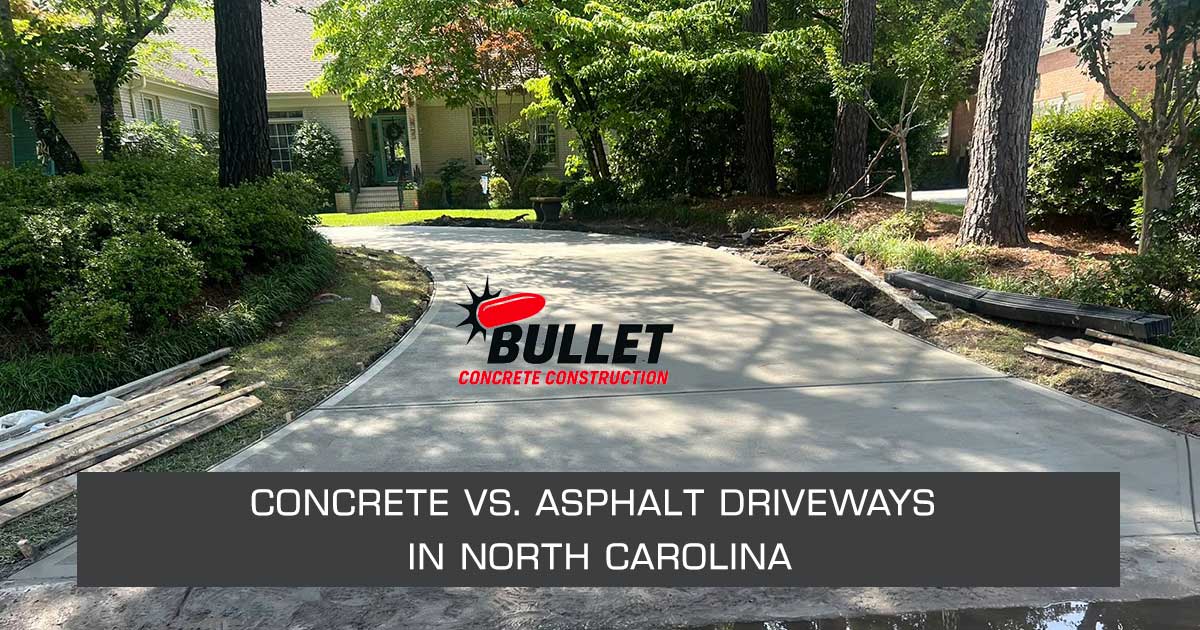
Concrete and asphalt are the two most common driveway materials in North Carolina — and the decision between them usually comes down to one question: should I pay less now or less over time? Asphalt has a lower upfront price tag. Concrete costs more to install but lasts significantly longer, requires less maintenance, and performs dramatically better in North Carolina's heat, humidity, and coastal conditions. That tradeoff is the core of this comparison.
We've already covered concrete vs. pavers and stamped concrete vs. natural stone in previous posts. This article puts concrete head-to-head with asphalt across cost, lifespan, maintenance, heat performance, appearance, environmental impact, and resale value — with specific attention to how North Carolina's climate affects both materials differently than what you'll read in a national-level comparison article.
Upfront Cost: Asphalt Is Cheaper to Install — But That's Where Its Advantage Ends
For a standard two-car driveway in the Wilmington area, asphalt typically costs 20 to 40 percent less than concrete to install. That's a real savings on day one, and it's the main reason some homeowners choose asphalt.
But the initial price comparison doesn't tell the full story. Asphalt requires seal coating every two to three years to maintain its surface integrity — a recurring cost that concrete doesn't have an equivalent to (concrete sealing is recommended but the consequences of skipping it are cosmetic rather than structural). Asphalt driveways also have a shorter lifespan — 15 to 20 years in North Carolina's climate versus 25 to 30 or more years for concrete — which means you'll likely need to replace an asphalt driveway at least once in the time a single concrete driveway would still be performing. When you factor in the seal coating costs and the earlier replacement, the total cost of ownership over 30 years tilts decisively in concrete's favor.
Heat Performance: Asphalt Softens in North Carolina Summers
This is the single biggest practical difference between the two materials in our climate — and the one that national comparison articles consistently understate because they're written for a national audience that includes cold-weather states where asphalt performs better.
Asphalt is a petroleum-based material that softens in heat. On a 95-degree day in Wilmington — which describes most of June, July, and August — the surface temperature of an asphalt driveway in direct sun can reach 140 to 160 degrees. At those temperatures, the asphalt becomes pliable enough that heavy vehicles (trucks, SUVs, boats on trailers) can leave visible impressions, depressions, and ruts in the surface. Kickstands, jack stands, and trailer tongues can punch directly into softened asphalt. Over multiple summers, these depressions accumulate and create an uneven, rutted surface that holds water and accelerates further deterioration.
Concrete doesn't soften in heat. It's a rigid material that maintains its structural integrity regardless of surface temperature. A concrete driveway that's been in direct sun all day on the hottest day of the year performs exactly the same as it does in January. For homeowners in southeastern North Carolina — where the hot season runs five to six months and direct sun is intense — this is a fundamental performance advantage that outweighs almost every other factor in the comparison.
Lifespan: Concrete Lasts Nearly Twice as Long
In North Carolina's climate, a well-installed asphalt driveway typically lasts 15 to 20 years before it needs full replacement. The combination of summer heat softening, UV degradation of the petroleum binder, sandy soil movement beneath the surface, and the heavy rainfall we get in southeastern NC all work against asphalt's longevity. The surface oxidizes and becomes brittle over time, developing alligator cracking — a network of interconnected cracks that looks like reptile skin — that indicates the material has reached the end of its serviceable life.
A properly installed concrete driveway — with a compacted gravel sub-base, steel reinforcement, correctly placed control joints, and periodic sealing — lasts 25 to 30 or more years in the same conditions. As we covered in our post on why concrete cracks in coastal North Carolina, the failures that shorten concrete's lifespan are almost entirely preventable through proper installation. When the sub-base, reinforcement, joints, and sealing are done right, concrete outlasts asphalt by a wide margin in every climate — and especially in the heat and humidity of the Southeast.
Maintenance: Asphalt Demands More — and the Consequences of Skipping Are Worse
Asphalt maintenance
Asphalt requires seal coating every two to three years to protect the surface from UV degradation and water infiltration. Without seal coating, the petroleum binder in the asphalt oxidizes, the surface becomes brittle, and cracks form that allow water into the base layer — which accelerates sub-base erosion on the sandy soil common across southeastern NC. Once water gets beneath the asphalt, the damage compounds quickly: the base erodes, the surface sinks, and what started as a small crack becomes a pothole. Crack filling is an additional maintenance task that needs to happen as cracks appear — and in our climate, cracks appear faster because of the thermal cycling between summer heat and winter cool.
Seal coating also creates a temporary mess. Fresh seal coat is essentially liquid tar that needs 24 to 48 hours to cure before you can drive on it, and it tracks black residue into garages, onto sidewalks, and into your home on shoes and tires for days after application. In the Wilmington heat, the smell can be intense during application and curing.
Concrete maintenance
Concrete maintenance consists of periodic sealing (every two to three years, recommended but not structurally critical) and occasional pressure washing to remove dirt, mildew, and organic staining. That's it. There's no equivalent to seal coating — no tar smell, no curing time, no black residue tracking through your house. If you skip a sealing cycle on concrete, the surface may show some cosmetic wear or salt air effects over time, but the structural integrity of the slab isn't compromised the way asphalt's is when seal coating is skipped.
Appearance: Concrete Offers Options, Asphalt Offers One Look
Asphalt comes in one color: black. When it's freshly seal coated, it looks clean and uniform. Between seal coatings, it fades to gray, develops an uneven patchy appearance, and shows every oil stain, tire mark, and crack with high contrast. There are no finish options, no color choices, no pattern possibilities, and no way to customize the appearance beyond the standard black surface.
Concrete offers a full spectrum of finish options. Standard broom finish delivers a clean, light-colored surface that reflects heat rather than absorbing it (more on that below). Stamped concrete replicates the look of brick, stone, slate, or cobblestone with custom color matching. Exposed aggregate reveals the natural stone within the concrete mix for a textured, organic look. Colored concrete uses integral dyes to create custom tones that complement your home's exterior. For homeowners who care about curb appeal — and most do when they're investing in a new driveway — concrete gives you options that asphalt simply can't match.
Surface Temperature and Your Home: Concrete Runs 20+ Degrees Cooler
This isn't just a comfort issue — it affects your energy bill. Asphalt's black surface absorbs solar radiation and can reach surface temperatures of 140 to 160 degrees on a typical Wilmington summer day. That heat radiates into the surrounding air, raising the ambient temperature around your home and making your air conditioning work harder to cool the house — especially if the driveway runs close to the foundation or garage.
Concrete's lighter color reflects significantly more solar radiation. On the same 95-degree day, a concrete driveway's surface temperature is typically 20 to 30 degrees cooler than an adjacent asphalt surface. That means less heat radiating toward your house, lower surface temperatures for walking barefoot to the mailbox (which anyone with kids or pets in North Carolina appreciates), and a driveway you can actually use as functional outdoor space during the summer months without the surface being painfully hot underfoot.
Oil and Fluid Stains: Different Materials, Different Realities
Asphalt advocates sometimes argue that oil stains are less visible on a black surface — and that's technically true. But that's because the entire surface is petroleum-based, so oil dissolves into and damages the asphalt rather than sitting on top of it. Motor oil and transmission fluid actually break down the binder that holds asphalt together, creating soft spots that deteriorate faster than the surrounding surface. The stain may be less visible, but the damage is more structural.
On concrete, oil stains are more visible — that's a fair point. But they sit on the surface rather than dissolving the material. A sealed concrete driveway resists oil penetration, and stains can be removed with a degreaser and pressure washer without damaging the concrete beneath. The stain is cosmetic and removable; on asphalt, the same fluid causes material degradation that's permanent.
Coastal NC Conditions: The Climate Favors Concrete on Every Front
National "concrete vs asphalt" articles often give asphalt credit for performing well in cold climates where freeze-thaw cycles are the primary threat. That's valid — asphalt's flexibility gives it an advantage in states with harsh winters. But North Carolina isn't that climate. Southeastern NC rarely sees hard freezes, and when it does, they're brief. The conditions we actually deal with — intense summer heat, high humidity, heavy rainfall, sandy soil, high water tables, and salt air near the coast — all favor concrete.
Heat: Concrete maintains rigidity at any temperature. Asphalt softens and deforms in summer heat.
Rain: Concrete's sealed surface sheds water via drainage pitch. Heavy rain accelerates asphalt's surface deterioration by washing out the seal coat and infiltrating cracks.
UV exposure: Concrete's surface is mineral-based and UV-stable. Asphalt's petroleum binder degrades under UV exposure, which is intense and year-round in southeastern NC.
Sandy soil: Both materials require a compacted sub-base. When settling occurs, concrete's rigid slab bridges small voids. Asphalt's flexible surface follows the contour of the base, showing every depression and soft spot immediately.
Salt air: Concrete can be sealed against salt intrusion. Asphalt has no comparable defense against airborne salt, which accelerates the oxidation of the petroleum binder on properties near the coast in Wrightsville Beach, Carolina Beach, and Southport.
Resale Value: Concrete Is the Standard in the Wilmington Market
In the Wilmington metro area, concrete driveways are the default expectation for residential properties. Asphalt driveways are uncommon in our market — they're far more prevalent in the Northeast and Midwest where cold-weather performance matters. When an asphalt driveway does appear on a listing in southeastern NC, it often raises questions from buyers rather than adding value. Is the asphalt in good condition? When was it last seal coated? How soon will it need replacement?
A clean concrete driveway — whether standard broom finish or stamped — is what buyers across Wilmington, Leland, Hampstead, and Castle Hayne expect to see. It signals a well-maintained property and doesn't trigger the mental math of "when will I need to replace this?" that an aging asphalt driveway creates.
Side-by-Side Comparison
| Category | Concrete | Asphalt |
|---|---|---|
| Upfront cost | Higher (20–40% more) | Lower |
| Total cost of ownership (30 yrs) | Lower (one installation) | Higher (seal coating + earlier replacement) |
| Lifespan (NC climate) | 25–30+ years | 15–20 years |
| Summer heat performance | Rigid at all temperatures | Softens and deforms in 90°+ heat |
| Surface temperature | 20–30° cooler than asphalt | 140–160°F in direct sun |
| Maintenance | Seal every 2–3 yrs (optional), pressure wash | Seal coat every 2–3 yrs (required), crack filling |
| UV resistance | Mineral-based, UV-stable | Petroleum binder degrades under UV |
| Oil and fluid stains | Visible but removable; no structural damage | Less visible but dissolves binder; permanent damage |
| Appearance options | Broom, stamped, colored, exposed aggregate | Black only |
| Resale impact (Wilmington market) | Market standard; adds value | Uncommon in market; can raise buyer concerns |
The Bottom Line for North Carolina Homeowners
Asphalt makes sense in cold climates where freeze-thaw resilience is the priority and summer temperatures stay moderate. North Carolina is not that climate. Here, the conditions that matter most — sustained summer heat, intense UV exposure, heavy rainfall, sandy soil, and salt air near the coast — all favor concrete. Asphalt's lower upfront cost is real, but it's offset by mandatory seal coating, a shorter lifespan, heat softening that damages the surface every summer, and a replacement timeline that means you'll pay for two asphalt driveways in the time one concrete driveway is still performing.
At Bullet Concrete Construction, we pour concrete driveways built for North Carolina's conditions — proper excavation, compacted gravel sub-base, steel reinforcement, engineered control joints, drainage pitch, and a professional seal coat on every project. Whether you want a clean broom finish, a stamped design that replicates the look of stone or brick, or a colored finish that matches your home, we'll build a driveway that handles everything this climate throws at it for decades.
If you're planning a new driveway or replacing one that's reached the end of its life, contact us for a free estimate. We serve homeowners across Wilmington, Leland, Rocky Point, Hampstead, Castle Hayne, and the surrounding communities with free on-site estimates and detailed written quotes — no obligation.
Related Articles
Concrete vs. Pavers for Your Wilmington Driveway: Cost, Durability, and Maintenance Compared
Stamped Concrete vs. Natural Stone Patios: Which Is Better for Coastal NC?
Why Concrete Cracks in Coastal North Carolina (And How to Prevent It)
Poured Concrete Retaining Walls vs. Block vs. Timber: What Lasts in Wilmington's Climate
When Is the Best Time to Pour Concrete in Wilmington, NC?
Explore Our Concrete Services
Concrete Driveways • Concrete Patios • Garage Slabs • Concrete Foundations • Retaining Walls • Stamped Concrete