Concrete vs. Pavers for Your Wilmington Driveway: Cost, Durability, and Maintenance Compared
By Bullet Concrete Construction | Wilmington, NC | March 2026
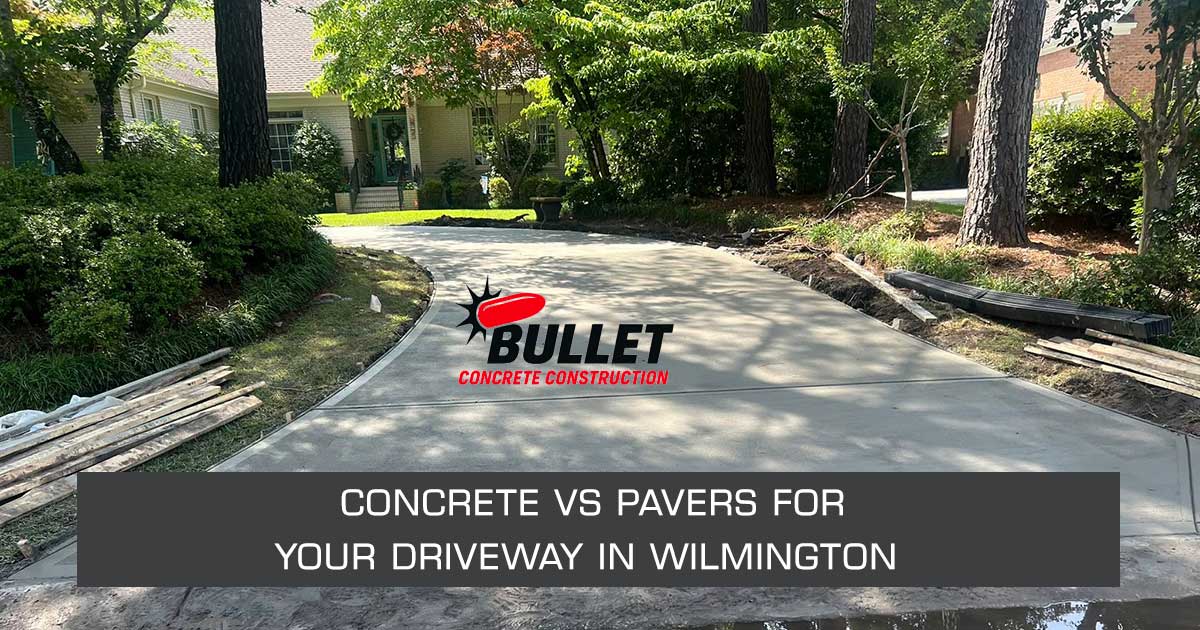
If you're replacing or installing a new driveway in the Wilmington area, you've probably come across two main options: poured concrete and interlocking pavers. Both are legitimate choices, both look good when installed correctly, and both can last a long time under the right conditions. But they're very different materials with different cost structures, maintenance requirements, and long-term performance characteristics — especially in a coastal climate like southeastern North Carolina where salt air, sandy soil, high water tables, and heavy seasonal rain all factor into how your driveway holds up over time.
This article compares concrete and pavers across the categories that actually matter to homeowners making this decision: upfront cost, long-term maintenance cost, durability in coastal conditions, appearance options, repair and replacement, and resale value. We pour concrete for a living, so we're obviously not a neutral party — but we'll give you the honest comparison so you can make the right call for your property and your budget.
Upfront Cost: Concrete Is Significantly Less Expensive
For a standard two-car driveway in the Wilmington area — roughly 600 to 800 square feet — a properly installed poured concrete driveway with a broom finish typically costs 30 to 50 percent less than an interlocking paver driveway of the same size. The gap gets wider if you're comparing standard concrete to premium pavers like natural stone or large-format architectural pavers.
The cost difference comes down to labor and material complexity. A concrete driveway is formed, poured, finished, and sealed in a single continuous process — usually completed in one to two days. A paver driveway requires excavation, a compacted gravel base, a sand setting bed, individual placement of every paver (which can number in the thousands for a full driveway), edge restraints to keep the perimeter locked in place, and polymeric sand to fill the joints. That's significantly more labor hours and more material components, which drives the installed price higher.
If you want the look of pavers without the paver price tag, stamped concrete is the middle ground. Stamped concrete can replicate the patterns and textures of brick, cobblestone, slate, or natural stone at a cost that's typically 20 to 40 percent less than actual pavers — while being poured as a single monolithic slab with no individual pieces to shift, settle, or come loose.
Durability in Coastal NC: Concrete Handles the Environment Better
This is where the Wilmington climate makes the comparison less straightforward than national-level articles suggest. In a dry, temperate climate, pavers and concrete perform roughly equivalently over time. In southeastern North Carolina, concrete has meaningful advantages.
Sandy soil and settling
Both concrete and pavers rely on a compacted sub-base to stay level. The difference is what happens when the base settles — and in our area's sandy soil, some degree of settling is almost inevitable over the long term. A poured concrete slab distributes load across its entire surface as a single rigid unit. If a small section of the base settles slightly, the slab bridges the gap without any visible change at the surface. Pavers don't have that bridging ability. Each individual paver is only as stable as the sand bed and base directly beneath it. When the base settles even slightly, individual pavers drop, creating uneven surfaces, trip hazards, and gaps between units. Over five to ten years on sandy Wilmington soil, you'll see this as a wavy, uneven driveway surface that requires periodic releveling.
Water and drainage
Paver driveways are sometimes marketed as "permeable" because water can drain through the joints between units. In practice, this permeability is a double-edged sword in our climate. The 55 to 60 inches of annual rainfall we get in southeastern NC pushes water through those joints constantly, washing out the polymeric sand that holds the pavers in place and eroding the sand setting bed beneath them. This is the number one maintenance issue with paver driveways in coastal areas — the joints need to be re-sanded every one to three years to keep the surface locked together. A sealed concrete driveway, by contrast, sheds water off the surface via the drainage pitch we build into every pour. The water never enters the slab structure.
Salt air exposure
Salt air affects both materials, but it affects them differently. On concrete, salt causes surface deterioration (spalling and pitting) that can be largely prevented with a penetrating sealer — something we apply as standard on every project and recommend resealing every two to three years. On pavers, salt doesn't attack the surface as aggressively, but it attacks the joints. Salt crystallization in the gaps between pavers accelerates the breakdown of polymeric sand and can cause efflorescence (white mineral deposits) on the paver surfaces that's more difficult to remove than on a smooth concrete surface. Properties on Wrightsville Beach, Carolina Beach, and Southport will see these effects most aggressively.
Weed and ant invasion
This is a factor that homeowners in cooler, drier climates don't deal with — but in Wilmington's warm, humid environment, it's a persistent issue with pavers. The joints between pavers provide a perfect environment for weed growth, grass encroachment, and ant colony establishment. Fire ants in particular are a constant battle on paver driveways and patios across southeastern NC — they tunnel through the sand bed and push material up through the joints, displacing pavers and creating structural instability beneath the surface. A poured concrete slab has no joints for weeds or insects to colonize.
Long-Term Maintenance: Concrete Requires Far Less
This is where the total cost of ownership comparison shifts even further in concrete's favor. The upfront price difference is meaningful on its own, but the ongoing maintenance gap makes it decisive for most homeowners.
Concrete driveway maintenance
A properly installed and sealed concrete driveway in the Wilmington area needs resealing every two to three years — a straightforward process that costs a fraction of the original installation. Beyond that, maintenance consists of occasional pressure washing to remove dirt, mildew, and organic staining (common in our humid climate) and monitoring for any cracks that develop at control joints. That's it. There are no joints to re-sand, no pavers to relevel, no weeds to treat, and no edge restraints to monitor. As we covered in our post on why concrete cracks, a well-installed slab with proper sub-base compaction, control joints, and sealing can last 30 years or more with minimal upkeep.
Paver driveway maintenance
A paver driveway in coastal NC requires significantly more ongoing attention. Polymeric sand in the joints needs to be topped off or fully replaced every one to three years as rain washes it out. Individual pavers that settle need to be lifted, the base re-leveled, and the pavers reset — a process that may need to happen across multiple sections of the driveway over its lifetime. Weed treatment and ant management in the joints is a recurring task throughout the growing season. Edge restraints need periodic inspection because shifting sandy soil can undermine them, allowing the outermost row of pavers to spread and loosen. And if you want to maintain the original appearance, pavers typically need sealing as well — the same maintenance step concrete requires, but applied to a surface with thousands of joints that complicate the process.
Over a 20-year span, the cumulative maintenance cost on a paver driveway in our climate can approach or even exceed the original cost difference between pavers and concrete — which means the "more expensive upfront" option ends up being the more expensive option overall.
Appearance Options: Pavers Have More Variety, but Stamped Concrete Closes the Gap
This is the one category where pavers have a genuine advantage. Interlocking pavers come in a wide range of shapes, colors, textures, and laying patterns — herringbone, basketweave, running bond, and custom designs that are difficult to replicate exactly with any other material. If you have a very specific architectural vision for your driveway and appearance is the top priority above all other factors, pavers offer the widest palette.
That said, stamped concrete has narrowed this gap significantly. Modern stamping techniques can replicate the look of brick, cobblestone, flagstone, slate, wood plank, and natural stone with color-matched integral dyes and surface-applied hardeners that produce remarkably realistic finishes. The visual difference between a well-executed stamped concrete driveway and a paver driveway is minimal at a normal viewing distance — and stamped concrete delivers that look as a single continuous slab with none of the joint, settling, or weed issues that come with individual pavers.
Standard broom-finish concrete is the most understated option visually, but that simplicity is exactly what many homeowners want — a clean, uniform, low-profile surface that lets the house and landscaping do the talking. For homeowners in Wilmington's established neighborhoods where the goal is a fresh, well-maintained driveway that complements the property without drawing attention to itself, standard concrete is the right call.
Repair and Replacement: Different Approaches for Different Problems
Paver advocates often point out that individual pavers can be replaced without tearing out the entire driveway — and that's true. If a single paver cracks or stains beyond repair, you can pull it out and drop in a new one. That's a genuine advantage for isolated, localized damage.
In practice, though, the types of damage that actually occur on driveways in coastal NC aren't usually isolated to a single paver. Settling from sub-base erosion affects entire sections. Joint failure from rain washout affects the full driveway. Ant damage undermines areas, not individual units. Fixing these issues means lifting, releveling, and resetting large sections of pavers — which is labor-intensive and often costs nearly as much as the original installation per square foot.
Concrete repair works differently. Hairline surface cracks that follow control joints are cosmetic and expected — they're literally what control joints are designed to create. Structural cracks or settling that indicate a sub-base failure can be addressed by cutting out and replacing the affected section without demolishing the entire driveway. On a properly installed concrete driveway with correct joint placement, a section replacement is clean, straightforward, and the new section bonds to the existing slab edges. We cover the full repair-vs-replace decision process in our post on how to tell if your concrete needs to be replaced or just repaired.
Resale Value: Both Add Value, but Condition Matters More Than Material
Real estate agents in the Wilmington market will tell you the same thing: buyers notice the driveway, but they notice its condition more than its material. A clean, well-maintained concrete driveway adds curb appeal and signals that the property has been cared for. A paver driveway that's settling, growing weeds, and showing displaced joints signals the opposite — even though the material itself may have been more expensive to install.
In the new-construction communities across Leland, Hampstead, and Castle Hayne, concrete driveways are the standard — it's what buyers expect to see and what appraisers use as the baseline. In the higher-end and historic neighborhoods of Wilmington, Wrightsville Beach, and Southport, a stamped concrete or well-maintained paver driveway can command a premium — but only if it's in excellent condition. A deteriorating paver driveway can actually reduce perceived value because buyers see it as a future maintenance burden.
Side-by-Side Comparison
| Category | Poured Concrete | Interlocking Pavers |
|---|---|---|
| Upfront cost | Lower (30–50% less) | Higher |
| Long-term maintenance cost | Low (reseal every 2–3 yrs) | High (re-sand, relevel, weed treatment) |
| Settling on sandy soil | Slab bridges small voids | Individual pavers drop and shift |
| Rain and drainage | Sheds water off surface | Water enters joints, erodes sand bed |
| Salt air resistance | Sealed surface blocks salt | Salt degrades joints, causes efflorescence |
| Weed and insect resistance | No joints to colonize | Joints attract weeds and fire ants |
| Appearance options | Broom, stamped, colored, exposed agg | Widest variety of shapes and patterns |
| Installation time | 1–2 days | 3–7 days |
| Typical lifespan (coastal NC) | 25–30+ years | 20–25 years (with regular maintenance) |
| Repair approach | Section cut-and-replace | Lift, relevel, reset area |
The Bottom Line for Wilmington Homeowners
Pavers look great on day one. So does concrete. The difference shows up over the following five, ten, and twenty years — and in a coastal climate with sandy soil, heavy rain, salt air, and fire ants, concrete holds up with dramatically less maintenance and lower total cost of ownership. If the paver aesthetic is what you're after, stamped concrete delivers a remarkably similar look as a single monolithic slab that doesn't have joints to fail, sand to wash out, or pavers to settle and shift.
At Bullet Concrete Construction, we install both standard and stamped concrete driveways for homeowners across Wilmington, Leland, Hampstead, Rocky Point, and the surrounding communities. Every driveway we pour starts with proper excavation, a compacted gravel sub-base built for our sandy coastal soil, steel reinforcement, engineered control joints, drainage pitch, and a professional seal coat — the preparation that makes the difference between a driveway that lasts three decades and one that starts failing in three years.
If you're weighing your options for a new or replacement driveway, contact us for a free estimate. We'll look at your property, discuss your goals and budget, walk you through the finish options including stamped patterns, and give you a detailed quote with no obligation.
Related Articles
Why Concrete Cracks in Coastal North Carolina (And How to Prevent It)
How Salt Air Affects Concrete in Wilmington, NC
What Wilmington's Sandy Soil Means for Your Concrete Project
Stamped Concrete vs. Natural Stone Patios: Which Is Better for Coastal NC?
Concrete vs. Asphalt Driveways in North Carolina: The Full Breakdown
Explore Our Concrete Services
Concrete Driveways • Concrete Patios • Garage Slabs • Concrete Foundations • Retaining Walls • Stamped Concrete