Poured Concrete Retaining Walls vs. Block vs. Timber: What Lasts in Wilmington's Climate
By Bullet Concrete Construction | Wilmington, NC | March 2026
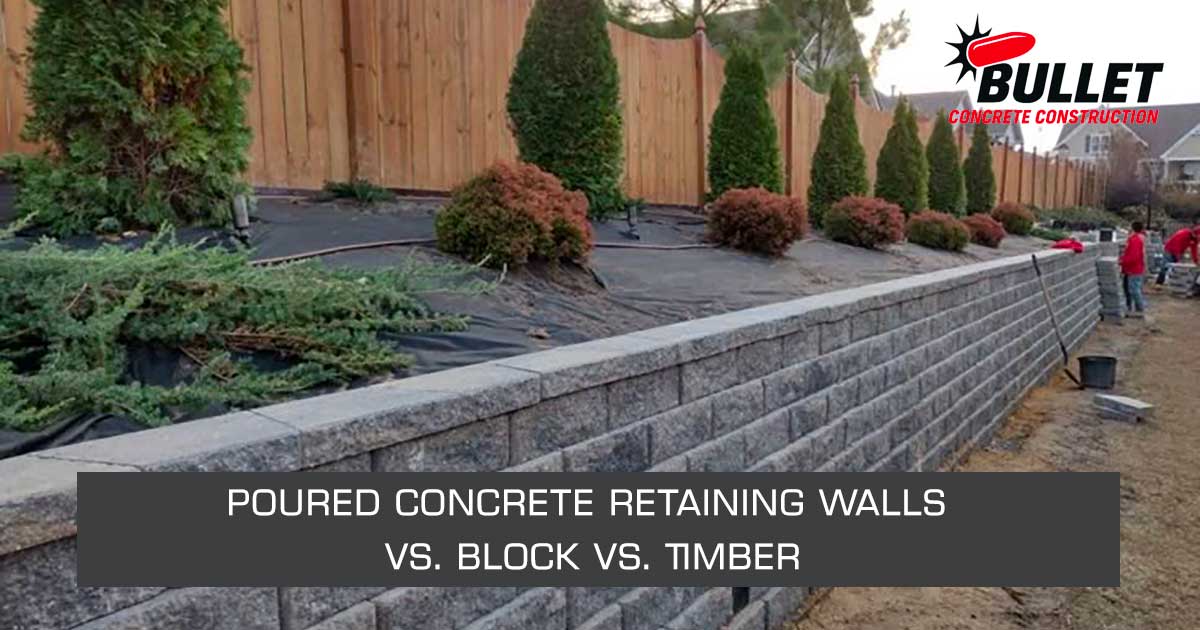
Retaining walls do essential work — holding back soil, managing water runoff, creating usable grade changes on sloped lots, and preventing erosion on properties near waterways. In southeastern North Carolina, where sandy soil shifts readily, water tables sit close to the surface, and heavy seasonal rain saturates the ground behind every wall, choosing the right material isn't just about aesthetics — it determines whether your wall is still standing and performing in ten years or whether it's leaning, cracking, or rotting its way toward replacement.
The three most common residential retaining wall materials are poured concrete, concrete masonry block (CMU), and pressure-treated timber. Each has strengths, but they perform very differently in our coastal climate. This article breaks down the comparison across structural capacity, durability in Wilmington's conditions, drainage, maintenance, cost, and lifespan — so you can make the right choice for your property.
Structural Strength: Poured Concrete Is in a Different Category
A poured concrete retaining wall is a single monolithic structure — one continuous mass of steel-reinforced concrete with no joints, no mortar lines, and no individual components that can shift independently. It's the strongest residential retaining wall material available. The steel rebar running through the wall ties it to the footing below and distributes both the lateral soil pressure behind the wall and any vertical loads on top of it across the entire structure as a unified system.
Concrete masonry block walls are assembled from individual units stacked and either dry-stacked with pins or mortared together. They can be reinforced with rebar grouted into the hollow cores, which significantly improves their strength — but even a reinforced block wall has mortar joints or interlock points that are inherently weaker than the blocks themselves. Those joints are where block walls fail first: mortar cracks under pressure, pins shear under lateral load, and once a joint opens up, the structural integrity of the wall above that point is compromised. An unreinforced block wall — which is what many residential contractors install to save time and cost — has even less capacity to resist the sustained soil and water pressure common in our area.
Timber retaining walls are the weakest structural option. Pressure-treated landscape timbers or railroad ties are stacked horizontally and anchored with rebar driven through pre-drilled holes into the ground behind the wall. The connection between timbers is only as strong as the friction between the wood surfaces and the anchoring pins — there's no continuous structural bond. Timber walls are adequate for low-height applications (two to three feet) where the soil pressure is minimal, but they lack the capacity to handle the loads that taller walls or saturated soil conditions create. In areas with high water tables — common across Castle Hayne, Winnabow, and Carolina Beach — timber walls are particularly vulnerable because the hydrostatic pressure from saturated soil behind the wall exceeds what the timber-and-pin assembly can resist.
Durability in Coastal NC: Moisture, Salt, and Insects Change Everything
Poured concrete
Poured concrete is the most durable retaining wall material in our climate. It doesn't rot, doesn't attract insects, and doesn't degrade from moisture contact. Salt air can affect the surface over time if left unsealed, but a penetrating sealer applied after curing blocks salt intrusion and extends the wall's surface life significantly. The only degradation mechanism that affects poured concrete in our area is sub-base erosion from water table fluctuations — and that's addressed through proper footing design and drainage, not a material limitation. A well-built poured concrete retaining wall in southeastern NC will last 40 to 50 years or more with minimal maintenance.
Concrete block
Block walls share concrete's resistance to rot and insects, but the mortar joints introduce a vulnerability that poured concrete doesn't have. In Wilmington's climate, mortar joints are constantly exposed to moisture from both the retained soil side and the face side. Over years of wet-dry cycling, mortar deteriorates — it cracks, softens, and eventually allows water to penetrate through the wall face. This is accelerated on waterfront properties in Wrightsville Beach and Southport where salt crystallization in the mortar joints speeds the breakdown. Dry-stacked segmental block walls avoid the mortar issue but rely on gravity, friction, and pins to resist lateral pressure — which makes them suitable for low walls but increasingly risky as wall height increases. A well-built, reinforced block wall typically lasts 25 to 35 years in our climate before mortar joints need significant repointing or the wall needs reconstruction.
Timber
This is where southeastern North Carolina's climate creates the most dramatic material difference. Pressure-treated timber is treated with preservatives to resist rot and insect damage, but "resist" is not "prevent" — especially in a climate with year-round moisture, high humidity, and one of the country's most aggressive termite populations. The Wilmington area is classified as a "very heavy" termite infestation zone by the USDA, and Formosan subterranean termites — which are particularly aggressive and can consume wood faster than native species — are established across southeastern NC.
Even without termite damage, pressure-treated timber in constant ground contact in our humidity will soften, warp, and develop internal rot within 10 to 15 years. The timbers split as they weather, the connections loosen as the wood shrinks and expands with moisture cycles, and the wall gradually leans forward as it loses structural integrity. On properties near waterways — where the soil behind the wall is perpetually saturated — timber wall failure can happen even faster because the wood never fully dries between rain events. A timber retaining wall in coastal NC has a realistic lifespan of 10 to 15 years before it needs full replacement, and many fail sooner.
Drainage: The Most Important Factor Most Homeowners Don't Consider
As we covered in detail in our high water table article, hydrostatic pressure — the lateral force created by water-saturated soil — is the number one cause of retaining wall failure in low-lying coastal areas. When the soil behind a retaining wall is saturated, the wall isn't just holding back dirt. It's holding back water. And water is heavier and creates more pressure per square foot than dry soil. Without a drainage system to relieve that pressure, every retaining wall material will eventually fail. The question is how quickly and how catastrophically.
Poured concrete drainage
Every poured concrete retaining wall we build includes a complete drainage system: a perforated drain pipe at the base of the wall embedded in drainage gravel, a gravel backfill layer between the wall and the retained soil, and weep holes through the wall face at calculated intervals. This system converts hydrostatic pressure into controlled water flow — groundwater moves through the gravel, into the drain pipe, and exits through the weep holes rather than building up against the wall. Because poured concrete is monolithic, water can't penetrate through the wall itself — it can only exit through the engineered drainage points, which means the system works predictably and the wall stays dry.
Block wall drainage
Block walls can accommodate the same drainage system — and should, in our climate. The challenge is that even with drainage behind the wall, water can penetrate through deteriorating mortar joints over time, which means the drainage system has to work harder as the wall ages. Dry-stacked segmental walls inherently allow some water through the gaps between blocks, which provides a degree of passive drainage but also means the wall face is perpetually damp — accelerating efflorescence, staining, and biological growth on the visible surface.
Timber wall drainage
Timber walls have the weakest drainage integration of the three options. While gravel backfill can be placed behind a timber wall, the wall itself has no weep holes and no engineered drainage path through the structure. Water that accumulates behind a timber wall either pushes through gaps between timbers (undermining the connections) or builds up until the pressure exceeds what the timber-and-pin assembly can resist. This is why timber walls in high-water-table areas lean and fail faster than the same wall would on well-drained higher ground — the drainage limitation is built into the material and construction method.
Maintenance: Three Very Different Levels of Effort
Poured concrete maintenance
Seal the wall face every three to five years to protect against salt air and moisture penetration. Pressure wash as needed to remove dirt, mildew, and biological staining. Inspect weep holes annually to make sure they're clear and draining properly. That's the full maintenance program. There are no joints to repoint, no timbers to replace, and no structural connections to monitor. A poured concrete retaining wall is as close to maintenance-free as a retaining wall can be.
Block wall maintenance
Mortared block walls need periodic joint inspection and repointing as mortar deteriorates — typically every five to ten years in our climate, more frequently on salt-exposed properties. Efflorescence on the block face needs to be cleaned and the source of moisture addressed. Drainage system components (drain pipe, weep holes if present) need the same annual inspection as poured concrete. Dry-stacked walls need periodic inspection for shifted blocks, especially after heavy rain events or tropical storms that saturate the soil behind the wall.
Timber wall maintenance
Timber walls require the most ongoing attention. Annual inspection for signs of rot, splitting, warping, and insect damage. Termite treatment around the wall perimeter on a preventive schedule — annual in our area. Replacement of individual timbers as they fail, which can be disruptive because removing a deteriorated timber from the middle of a wall often requires disassembling the section above it. Monitoring for forward lean, which accelerates once it starts because the geometry shifts the load further from the wall's center of resistance. Most timber walls in southeastern NC reach a point between years 8 and 12 where the maintenance cost of keeping them functional exceeds the cost of replacement.
Cost: Upfront vs. Total Cost of Ownership
Timber is the least expensive to install, block is in the middle, and poured concrete is the most expensive upfront. That's the order most homeowners expect — and it's accurate for day-one cost.
But retaining walls aren't driveways or patios. They're structural elements that hold back thousands of pounds of soil and water pressure 24 hours a day, 365 days a year. When a retaining wall fails, the replacement isn't just the wall — it's the excavation, the soil remediation behind it, the drainage system rebuild, potentially the regrading of the slope, and any damage to landscaping, fencing, or structures that were affected by the failure. A timber wall that costs 40 percent less to install but fails in 10 years and takes out a section of fence and landscaping when it goes is not a cost savings. It's a deferred expense with compounding damage.
Over a 30-year ownership period, poured concrete is the lowest total cost option because it's a one-time installation with minimal maintenance and a 40 to 50 year lifespan. Block is in the middle — longer-lived than timber but requiring periodic mortar maintenance. Timber is the most expensive long-term option because you'll replace it at least twice in the time a single poured concrete wall is still performing — and each replacement includes the cost of demolishing the failed wall, re-excavating, and rebuilding the drainage.
Appearance: Each Material Has Its Place
Poured concrete delivers a clean, smooth, modern wall face that can be left natural, sealed with a clear finish, or stained to complement the home's exterior. For properties with a contemporary or minimalist aesthetic, poured concrete's uniform surface is the most architecturally aligned option. The wall can also be formed with textured form liners that imprint patterns — stone, brick, or wood grain — into the concrete surface during the pour.
Concrete block offers the most variety in surface texture and color. Segmental retaining wall blocks come in split-face, tumbled, smooth, and ledgestone textures with multiple color blends. For homeowners who want a wall that blends with natural landscaping or matches a stone-accented home exterior, block provides the widest aesthetic palette. The tradeoff is the mortar joint maintenance that comes with it in our climate.
Timber has a natural, rustic appearance that suits wooded lots and informal landscape designs. When it's new, pressure-treated timber looks warm and organic. Within two to three years in Wilmington's humidity, it grays, splits, and develops the weathered look that some homeowners appreciate and others find deteriorated. By year five to seven, most timber walls in our climate look visibly aged regardless of maintenance, and by year ten they typically look like they need replacement.
Side-by-Side Comparison
| Category | Poured Concrete | Concrete Block | Timber |
|---|---|---|---|
| Structural strength | Highest — monolithic, steel-reinforced | Moderate — joints are weak points | Lowest — friction and pin connections |
| Lifespan (coastal NC) | 40–50+ years | 25–35 years | 10–15 years |
| Rot and insect resistance | Immune | Immune | Vulnerable (termites, rot) |
| Hydrostatic pressure resistance | Excellent with drainage system | Good with drainage; mortar joints degrade | Poor — no engineered drainage path |
| Salt air resistance | Excellent when sealed | Moderate; salt attacks mortar joints | Poor; salt accelerates wood degradation |
| Maintenance | Minimal — seal, pressure wash | Moderate — repoint mortar, inspect | High — termite treatment, timber replacement |
| Upfront cost | Highest | Middle | Lowest |
| Total cost (30 yrs) | Lowest (one installation) | Middle | Highest (2–3 replacements) |
| Appearance options | Smooth, stained, textured forms | Widest variety of textures and colors | Rustic/natural; grays and weathers quickly |
| Max practical height | 6+ feet (engineered) | 4–6 feet (reinforced) | 2–3 feet |
When Each Material Makes Sense in Southeastern NC
Choose poured concrete when the wall is taller than three feet, when the property has a high water table or sits in a flood zone, when the retained soil will be perpetually saturated, when the wall is structural (supporting a driveway, structure, or significant grade change), on any waterfront or barrier island property where salt exposure and moisture are constant, or when you want a wall that you install once and don't think about for decades. This covers the majority of retaining wall projects across Wilmington, Castle Hayne, Winnabow, Carolina Beach, and Southport.
Choose reinforced block when appearance variety is a priority and you're willing to commit to mortar maintenance over the wall's life, when the wall is under four feet and the soil behind it drains reasonably well, or when the budget doesn't allow for poured concrete but you want a permanent masonry solution. Block makes the most sense on higher-ground properties in Leland, Hampstead, and the Wilmington neighborhoods with better natural drainage.
Choose timber only for very low walls (under two feet) in decorative garden or landscape applications where structural failure wouldn't cause property damage, and only if you accept that the wall will need replacement within 10 to 15 years. Timber is not recommended for any structural retaining application in coastal NC.
Build the Wall Right the First Time
Retaining walls aren't decorative features you can easily swap out if they don't perform. They're structural elements that hold back soil and water under constant pressure, and replacing a failed wall is significantly more expensive and disruptive than the original installation. In a coastal climate with saturated soil, termites, salt air, and heavy rain, the material choice matters more here than almost anywhere else in the country.
At Bullet Concrete Construction, we build poured concrete retaining walls with steel reinforcement, engineered footings, full drainage systems, and protective sealing as standard. Every wall is designed for the specific soil conditions, water table, and load requirements on your property — whether it's a grade change on a riverfront lot in Rocky Point, erosion control near Town Creek in Winnabow, or a structural wall supporting a driveway on a sloped lot in Wilmington.
If you need a retaining wall — or if you have an existing wall that's leaning, cracking, or showing signs of failure — contact us for a free estimate. We'll assess your property's grade, soil, and drainage conditions and give you a plan built for the long term.
Related Articles
High Water Tables and Concrete: What Wilmington Homeowners Need to Know
What Wilmington's Sandy Soil Means for Your Concrete Project
Concrete vs. Pavers for Your Wilmington Driveway: Cost, Durability, and Maintenance Compared
Why Concrete Cracks in Coastal North Carolina (And How to Prevent It)
How to Tell If Your Concrete Needs to Be Replaced or Just Repaired
Explore Our Concrete Services
Concrete Driveways • Concrete Patios • Garage Slabs • Concrete Foundations • Retaining Walls • Stamped Concrete